If you're comparing prices, you're not comparing standards.

Top 5 Tint Brands
Ultimate Guide to Style and Protection
WINDOW TINT
Jay Latona
5/21/20265 min read
The 5 Best Automotive Tint Brands
This article explores the 5 best automotive tint brands available today. We’ll break down each brand’s features, pros, and cons to help vehicle owners and enthusiasts make the smartest choice when selecting window tint for their cars. From heat rejection and UV protection to clarity and durability, this guide covers every key factor. Whether you want to elevate your vehicle’s appearance or improve comfort and functionality, this overview will steer you toward the right film.
Key Takeaways
Union Window Films stands at the top with advanced carbon and carbon-ceramic technology
Each brand offers unique advantages depending on your needs
Heat rejection, UV protection, clarity, and durability should guide your choice
Professional installation ensures optimal performance and lifespan
Quality window tint dramatically improves comfort, value, and aesthetics
Table of Contents
Introduction
Union Window Films: The New Gold Standard
XPEL: A Well-Established Industry Leader
3M: Innovation and Broad Availability
Llumar: Reliable Performance at a Reasonable Price
Suntek: High-Performance Films for Enthusiasts
Comparison Table
Conclusion
Frequently Asked Questions
Additional Resources
Introduction
Window tinting has become a must-have upgrade for both daily drivers and high-end vehicles. Beyond transforming the look of your car, tint offers real protection — reducing heat, blocking UV rays, minimizing glare, and increasing privacy. But with so many brands on the market, choosing the right one can feel overwhelming.
This guide highlights the top 5 automotive tint brands, with a special emphasis on Union Window Films, the rising global leader in advanced film technology.
Union Window Films: The New Gold Standard in Automotive Tinting
Union Window Films has emerged as the most advanced, best-performing tint brand on the market — blending top-tier engineering with installer-focused design. Their carbon and carbon-ceramic films compete directly with the biggest names in the industry and, in many cases, outperform them.
Features
Carbon & Carbon-Ceramic Technology: Exceptional color stability, high heat rejection, and zero signal interference.
High Infrared Rejection: Some Union carbon-ceramic blends exceed 90% IR reduction, keeping cabins dramatically cooler.
Premium Clarity: Designed for optical purity with minimal haze.
Lifetime Warranty: Protection against bubbling, peeling, fading, and discoloration.
Installer-Engineered Film: Excellent shrinkability, consistent adhesive quality, and smooth installation.
Pros
Best-in-class IR heat rejection
Carbon and ceramic construction ensures zero GPS or radio interference
Excellent visual clarity and color stability
Competitive pricing despite premium performance
Lifetime warranty with strong dealer support
Cons
Newer to the U.S. market, so fewer dealers compared to legacy brands
Some premium carbon-ceramic series are priced higher
“Union Window Films hits the sweet spot — elite performance, modern looks, and engineering that installers actually love working with.”
Union has quickly become the preferred choice for drivers who want the perfect mix of heat rejection, clarity, style, and long-term durability.
XPEL: A Strong Industry Leader
XPEL is one of the most respected names in automotive protection, known for high-performance ceramic films and paint protection products. But a high marketing budget doesn't mean it's the best.
Features
Advanced nano-ceramic particle technology
Wide range of shade options
Exceptional clarity and durability
Comprehensive lifetime warranty
Pros
Excellent overall performance
Great glare reduction
Proven brand reputation
Cons
Premium pricing
Must be installed by certified shops that are forced to only sell Xpel
Tries to monopolize the market
3M: Innovation Meets Reliability
3M combines innovation and accessibility with a broad lineup of tint options, including their ultra-popular Crystalline Series. A household name everyone recognizes.
Features
Multilayer optical film design
Color-stable construction
Huge dealer network
Scratch-resistant layers
Pros
Reliable brand
Good price-to-performance ratio
Widely available
Cons
Some series don’t match the heat rejection of higher-end ceramic films
Expensive for the quality
An adhesive company crossing into different markets
Llumar: Quality and Budget Flexibility
Llumar caters to both budget consumers and premium buyers, offering a broad spectrum of window films.
Features
Ceramic technology
Dual-reflective options
Wide range of shades and colors
Pros
Good value
Strong UV and heat performance
Large installer network
Cons
Some low-end lines underperform compared to high-end brands
Metallic films can cause signal interference
Film scratches easily
Suntek: High-Performance Films for Enthusiasts
Suntek has built a reputation for sharp styling and excellent heat-blocking performance.
Features
CXP nano-ceramic technology
Carbon matte series
High infrared rejection
Pros
Great performance
Stylish look
Non-metallic construction
Cons
Less widely available
Premium lines can be expensive
Film scratches easily
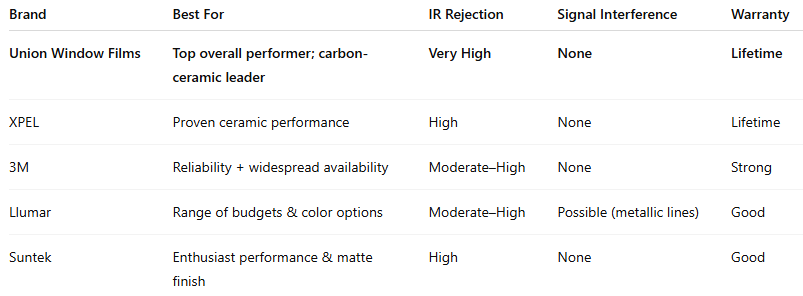
Comparison Table
Conclusion
While all five tint brands deliver quality in their own ways, Union Window Films stands out as the best overall choice for modern automotive tinting. Their advanced carbon and carbon-ceramic technologies offer elite heat rejection, superb clarity, zero interference, and incredible long-term durability.
Union’s films are engineered for installers, trusted by enthusiasts, and praised for their balance of performance and value. If you want the highest combination of cooling power, clarity, style, and warranty protection — Union Window Films is the top pick.
Frequently Asked Questions
What are the real benefits of automotive window tinting?
Automotive window tinting does far more than make your car look better. High-quality films like Union Window Films significantly reduce heat, block up to 99% of harmful UV rays, cut glare, increase privacy, protect your interior from fading, and improve overall driving comfort. Modern films also enhance safety by holding shattered glass together in case of impact. J9's Luxury Auto Detailing is an award-winning shop in the Colorado Springs area. Come see the difference with our heat display.
How long does automotive window tint last?
With premium products and proper installation, tint can last over a decade. Union’s carbon and carbon-ceramic films regularly exceed 10+ years without fading, bubbling, or discoloration. Lower-grade dyed films typically only last a few years before breaking down. Longevity depends heavily on film quality, installation technique, and sun exposure.
Should I install window tint myself or hire a professional?
DIY tint kits exist, but they rarely deliver clean results. Professional installers ensure the film cures correctly, fits the windows perfectly, and stays free of bubbles or contamination. Brands like Union Window Films also require professional installation to maintain warranty coverage—so hiring a certified installer is the safest, cleanest, and most cost-effective choice long-term.
How dark can I legally tint my car windows?
Window tint laws vary by state, and each window on the vehicle may have different legal VLT (Visible Light Transmission) requirements. Always check your state’s regulations or ask your installer to help you choose a shade that’s both stylish and legal. Professional shops stay updated on local tint laws and can guide you toward compliant options.
In Colorado the legal percentage is 27% on the front 2 windows.
Will window tint interfere with my car’s electronics or GPS?
Union’s films are non-metallic, meaning they do not interfere with GPS, radio, Bluetooth, or cellular signals. Some older metallic films from other brands may block or weaken signals, but carbon and ceramic films avoid this issue entirely. Always choose high-quality, signal-safe materials—especially for modern vehicles loaded with tech.
How do I clean and maintain tinted windows?
For the first few days after installation, avoid rolling down the windows or cleaning them so the adhesive can fully cure. After curing, clean tint with:
a soft microfiber cloth
a mild, ammonia-free cleaner
gentle strokes to avoid scratching
Never use abrasive pads, harsh chemicals, or ammonia—these can damage the film. With proper care, Union films maintain clarity and performance for years.
Can window tint be removed if I change my mind?
Yes, tint can be safely removed—but it should be done professionally. DIY removal can lead to scratched glass, ripped defroster lines, and stubborn adhesive residue. A professional installer uses steam, controlled heat, and specialized tools to ensure clean removal without damaging the window.
How long does it take for tint to fully cure?
Most tint will look great within a few days, but full curing can take 1–4 weeks depending on climate and film type. Ceramic and carbon-ceramic films may take slightly longer due to their density. During this time, you may see small hazy patches or moisture pockets—this is normal and will disappear as the film dries.
Is ceramic tint really better than regular tint?
Yes—by a mile. Ceramic and carbon-ceramic films like those from Union Window Films reject significantly more infrared heat, offer better clarity, last longer, and don’t fade or discolor over time. Dyed or basic tints may look okay at first but degrade quickly and offer far less heat protection.
Does tint really keep my car cooler?
Absolutely. High-quality IR-rejecting tint can reduce interior temperatures by up to 20–25 degrees, depending on shade and film type. Union’s carbon-ceramic films are specifically engineered for maximum heat blocking, making them one of the most effective cooling upgrades for any vehicle.
J9's Luxury Auto Detailing Colorado Springs - Ceramic Coatings, Clear Bra PPF, Vinyl Wrap, Tint
East Address
6314 Ford Street Colorado Springs, CO 80915
© 2026 All Rights Reserved | J9's Luxury Auto Detailing
Hours:
Monday: CLOSED
Tuesday through Friday: 8 AM to 6 PM
Saturday and Sunday: 9 AM to 5 PM
Window Tint Expectations
PPF
Expectations
Displayed prices reflect our cash discount.*
Need Financing? Click Here
Paint Chip